
Research
My research focuses on how plants evolve and diversify across spatial and temporal scales. Using an integrative approach that combines field ecology, phylogeography, and genomic analyses, I examine models of plant speciation and the role of ecological interactions in shaping evolutionary divergence. Plant-pollinator interaction is a compelling subject for investigating the links between microevolution and macroevolution. Uneven distribution of animal pollinators forms geographic mosaics at the landscape level. How do plants respond and evolve to a geographic mosaic in pollinator availability? I investigate key questions of pollinator-driven speciation in the SE Asian genus Aeschynanthus (Gesneriaceae).
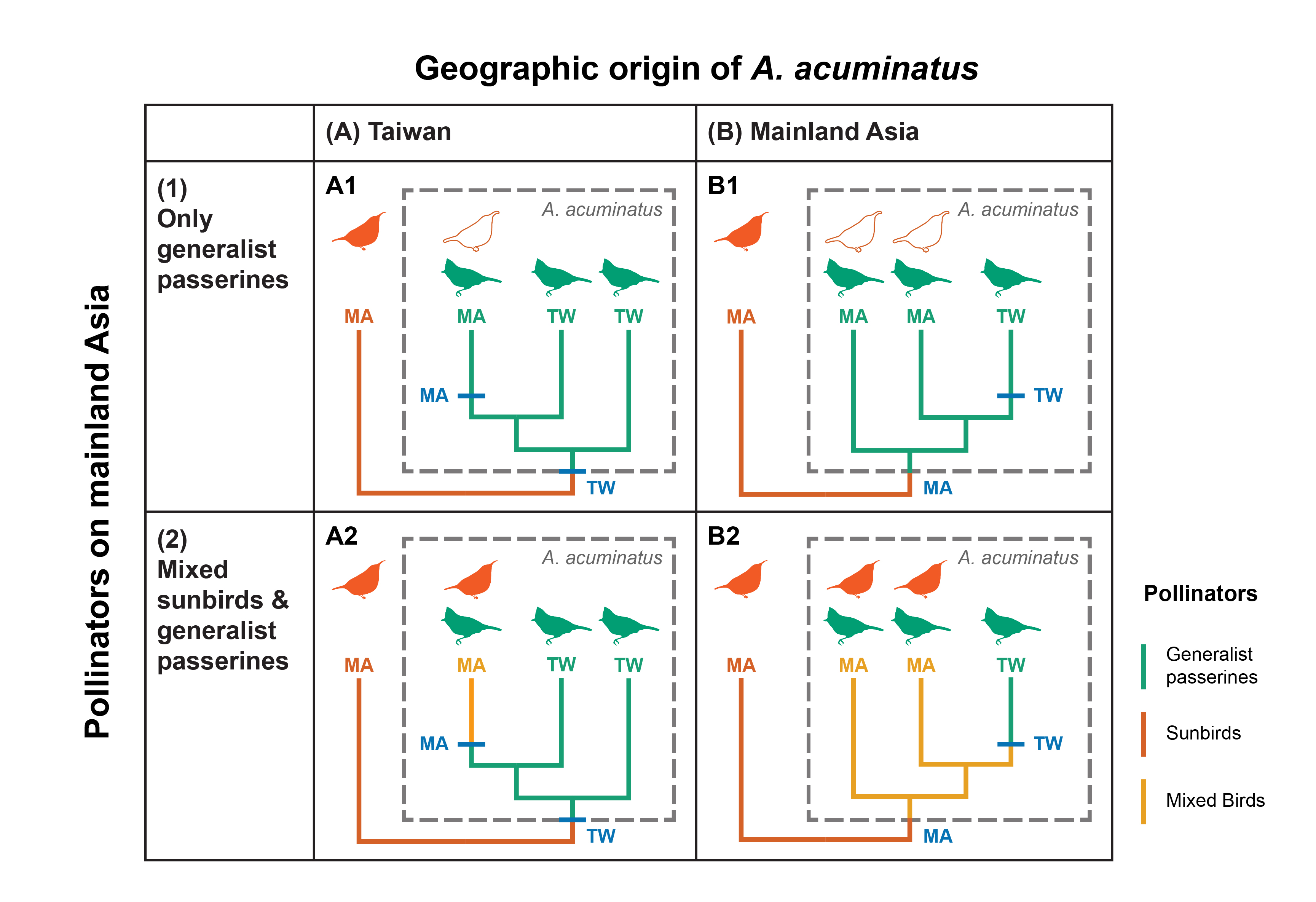
Can the classic pollinator-driven speciation model explain species origin?
The classic Grant-Stebbins model of pollinator-driven speciation predicts that a plant species encountering different pollinators across its range may undergo local adaptation and, subsequently, ecological speciation. The pollinator shift to generalist bird, derived from sunbird specialist ancestors, in the East Asian Aeschynanthus acuminatus (Gesneriaceae) provides an unique opportunity to ask if the classic model can explain its origin. I test among evolutionary scenarios by integrating studies of phylogeography, pollination, and floral morphology.
Publication: Lu et al. 2026 New Phyt.
More research to come. My previous research can be found here.